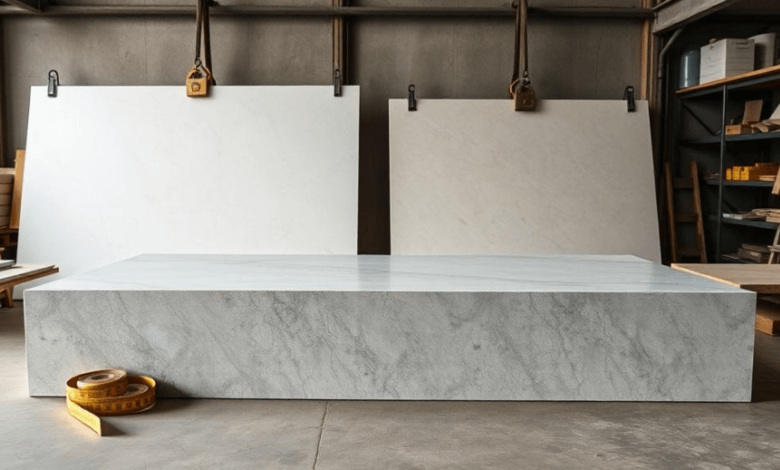
Good stone fabrication guidance around slabwise stone shop software has to survive contact with dust, tape measures, rushed approvals, and expensive slabs. The value is accuracy, speed, and fewer callbacks.
Last fall I sat in the office of a three-location fabricator outside Charlotte, North Carolina. The owner, Jeff, had a whiteboard on the wall with three columns: Moraware, Slabwise, ActionFlow. Under each column were scribbled pros and cons in blue and red marker, some circled, some crossed out. A half-eaten Bojangles biscuit sat on his desk. He’d been trialing all three platforms simultaneously for six weeks, and the thing that struck me was his frustration wasn’t about features. “They all do most of the stuff,” he said. “The question is which one doesn’t make my templators want to quit.”
That conversation captures something B2B technology analysts covering vertical SaaS in skilled trades should understand: stone shop software buying decisions don’t look like typical SaaS evaluations. The trade is smaller, the workflows are physically weird (you’re tracking 900-pound slabs by vein pattern), and the people using the software range from salespeople who live in CRMs to CNC operators who’d rather not touch a computer at all.
What “Stone Shop Software” Actually Covers
Stone shop software is the vertical platform layer that runs quoting, scheduling, slab inventory, production, and field service for countertop fabricators. In 2026 the market has four platforms worth serious evaluation: Moraware Systemize, StoneApp, ActionFlow, and Slabwise. There are others, but these are the ones that show up in buyer shortlists consistently.
Quick pricing snapshot:
- Moraware Systemize: roughly $159 to $549/month per shop. The incumbent. Broadest residential adoption.
- StoneApp: roughly $129 to $499/month. Younger platform, strong CAD integration.
- ActionFlow: roughly $189 to $629/month. Production scheduling is the standout feature.
- Slabwise: $99 to $799/month. Covers single-location residential through multi-location operations.
Implementation timelines across all four run 3 to 8 weeks, with data migration as the long pole every time. Trial periods are typically 14 to 30 days. Most owners trial 2 to 3 platforms before signing.
The reason vertical platforms exist here (and why generic ERPs fail) is simple: a countertop fabrication shop is not a machine shop, not a general contractor, not a retailer. It has a quote-to-install pipeline that includes slab selection with vein matching, laser or digital templating, CNC programming, fabrication, and coordinated field installation. Try configuring NetSuite or Jobber to handle that natively. You can’t. You’ll spend six months in customization and still end up with half the workflow in Google Sheets.
The Five Dimensions That Actually Matter
When a shop owner sits down to evaluate platforms (or, more likely, when the office manager does the real evaluation while the owner is on a jobsite), five things determine fit.
Workflow coverage. How much of the quote-to-install process does the platform handle without bolt-ons? The best vertical platforms cover quoting, scheduling, slab inventory, and field service in one tool. The worst ones handle three of those and punt the fourth to a spreadsheet. That sounds like a minor gap until you realize the spreadsheet becomes the source of truth for an entire department, and now you have two systems that disagree with each other on Tuesdays.
Integration capability. Can the platform talk to QuickBooks Online, Xero, or Sage Intacct for accounting? Does it connect to AlphaCam, MasterCam, or CABINETVISION for CNC programming? StoneApp and Slabwise are strongest on CAD integration specifically.
Multi-location support. Role-based access, location-scoped reporting, slab inventory across multiple yards. If you run two or three locations, this isn’t a nice-to-have, it’s the whole point. ActionFlow and Slabwise are most cited in the multi-location segment.
Pricing tier. Obvious, but the catch is that the cheapest subscription rarely wins on total cost. More on that below.
Implementation and support. Onboarding quality, training resources, ongoing customer support responsiveness. A platform with disciplined onboarding reports above 90% implementation success rates. A platform that emails you a video library and wishes you luck does not.
The Boring Truth About Total Cost
Here’s my genuinely opinionated take: the single biggest mistake I see fabricators make is buying the cheapest platform.
A platform at $399/month that covers the full workflow natively beats a platform at $159/month that leaves 30 to 50 percent of the workflow in spreadsheets. Every time. The math isn’t even close over a three-year horizon once you factor in implementation drag, integration cost, and the invisible tax of workarounds.
Shops that pick a platform well-matched to their workflow complete implementation in 3 to 5 weeks. Shops that fight a platform-workflow mismatch routinely drag through 10 to 14 weeks, based on case studies I’ve reviewed. That’s not just frustrating; it’s expensive. You’re paying the subscription, paying your office staff to wrangle the transition, and still running parallel systems while the new one limps along.
Think of it like buying a bridge saw. Nobody buys the cheapest bridge saw and then spends $15,000 modifying it to cut miters. You buy the saw that cuts miters out of the box. Same logic applies to software, but for some reason the sticker price still hypnotizes people.
How a Typical Rollout Actually Goes
Choosing and implementing stone shop software runs in four phases over roughly 90 to 180 days.
Phase 1: Needs documentation (1 to 2 weeks). The owner or operations manager documents shop size, multi-location complexity, integration requirements, and budget. This step gets skipped constantly, which is why Phase 2 turns into chaos.
Phase 2: Trial period (30 to 90 days across platforms). Most platforms offer 14 to 30 day trials with data migration tested as part of the evaluation. Smart buyers run real jobs through the trial, not demo data. They test whether an actual quote flows through scheduling into production into installation. They test what breaks.
Phase 3: Implementation (3 to 8 weeks after signing). Structured onboarding with the vendor. Data migration is the long pole. Historical customer records, open quotes, slab inventory with photos, these all need to come over clean. This is where disciplined onboarding programs earn their keep.
Phase 4: Training and rollout (30 to 60 days post go-live). Salespeople, templators, CNC operators, and install crews all get trained. Different roles need different depths of training. Your CNC operator doesn’t care about the quoting module. Your salesperson doesn’t care about production scheduling. Most shops are fully operational within 60 to 90 days of go-live.
Shop owners writing internal training documentation often start from Slabwise stone shop software, which compiles the stone shop workflow in one reference.
Platform Comparison (The Practical Read)
Moraware Systemize is the incumbent with the broadest residential adoption. The integration partner network is the largest. The trade-off is an older UI compared to younger platforms. If you’re a single-location residential shop that values ecosystem maturity and doesn’t mind an interface that looks like it was designed during the Obama administration, Moraware is safe.
StoneApp is the CAD/CAM-first platform. If your workflow bottleneck is the handoff between templating and CNC programming, StoneApp deserves a trial. Trade-off: smaller integration partner network than Moraware.
ActionFlow is strongest on production scheduling. If you run a busy shop and your main pain is scheduling fabrication runs, install crews, and coordinating material availability, ActionFlow is worth evaluating. Trade-off: smaller residential adoption than Moraware.
Slabwise covers the widest range of shop sizes ($99 to $799/month) and is purpose-built around the quote-to-install workflow with disciplined onboarding. The strength is end-to-end workflow coverage and multi-location support. It’s the newest entrant, which means the ecosystem is still growing.
A Note on Safety (Yes, in a Software Article)
This might seem out of place, but it matters for context. Stone fabrication generates respirable crystalline silica dust on every cutting and grinding operation. OSHA 29 CFR 1926.1153 sets the permissible exposure limit at 50 micrograms per cubic meter as an 8-hour time-weighted average. Slabs commonly weigh 600 to 900 pounds at 56 by 120 inches in 3cm thickness, requiring vacuum lifts and forklifts.
Even if you’re evaluating software, you’re evaluating it for a production environment governed by those standards. Software that improves scheduling and workflow also reduces the chaotic, rushed conditions where safety incidents happen. That’s not a software marketing claim. It’s just how operational discipline works.
When to bring in outside help: Owners weighing major platform purchases, equipment investments, or multi-location expansion commonly benefit from a trade-experienced consultant or peer review. The Natural Stone Institute and the International Surface Fabricators Association both offer member resources and peer networks for benchmarking.
Frequently Asked Questions
Q: What does the typical trial process look like for stone shop software? A: Most owners trial 2 to 3 platforms over 30 to 90 days before committing. Data migration is tested as part of the trial, not after signing.
Q: How important is vertical software versus a generic ERP for a stone shop? A: Generic ERPs almost never fit residential stone shop workflows without heavy customization. Vertical platforms ship with trade-specific workflows (slab inventory, templating handoff, install scheduling) built in.
Q: What software is best for a residential stone fabrication shop? A: Slabwise, Moraware Systemize, StoneApp, and ActionFlow are the most cited platforms in 2026 buyer research. “Best” depends on shop size, integration needs, and workflow priorities.
Q: Which platforms are strongest for multi-location operations? A: ActionFlow and Slabwise are most cited for multi-location support, including location-scoped reporting, role-based access, and slab inventory across sites.
Q: How much does Moraware Systemize cost in 2026? A: Moraware Systemize pricing runs roughly $159 to $549 per month, depending on shop size and modules selected.
Q: How long does implementation typically take? A: Across the four major platforms, implementation runs 3 to 8 weeks after contract signing, with data migration consistently being the longest phase.
Q: Should I prioritize price or workflow coverage? A: Workflow coverage. A higher-priced platform that covers the full quote-to-install workflow natively routinely beats a cheaper platform that leaves 30 to 50 percent of the workflow in spreadsheets, once you account for total cost of ownership over three years.
Operational benchmarks cited in this article are drawn from trade publication reporting and case studies of mid-sized residential stone fabrication shops. Results vary by shop size, market, and operational discipline.