A single-person sauna cabin fits into roughly a 4-foot by 4-foot footprint, and a two-person unit typically needs about 4.5 by 6 feet once heater clearance and door swing are accounted for. A 6kW electric heater is usually enough for either size, provided the cabin stays under about 300 to 350 cubic feet and the ceiling isn’t unusually tall. The limiting factor in most backyard installs isn’t the heater itself, it’s finding a corner with the electrical capacity, guard clearance, and drainage a small cabin actually needs.
What Counts as “Small” When Sizing a Backyard Cabin?
Most manufacturers treat anything under about 350 cubic feet as a compact install, which covers the bulk of one and two-person cabins sold for backyard use. A 4-foot by 4-foot cabin with a 7-foot ceiling comes out to 112 cubic feet, well within range for a 4.5kW to 6kW heater. Once a build stretches past two people or adds a bench-length window wall, the cubic footage climbs fast, and the heater math needs to climb with it. Measuring the actual corner of yard you’re working with, not just picturing a size, is the first real step, since fence lines, utility meters, and property setbacks often shrink the usable footprint more than people expect.
How Much Cubic Footage Does a 6kW Heater Actually Cover?
A commonly used rule of thumb puts one kilowatt of heater output against roughly 45 to 60 cubic feet of well-insulated cabin space, so a 6kW unit comfortably covers 270 to 360 cubic feet under normal conditions. That range assumes a properly insulated cedar or spruce shell with a vapor barrier behind the paneling. A cabin with extra glass, a poorly sealed door, or an uninsulated floor will run short of that range even though the raw cubic footage looks fine on paper. Buyers squeezing a cabin into a tight yard corner should ask any retailer for the specific heater’s coverage chart rather than relying on a generic rule, since guard rail style and stone load both shift the real-world number slightly.
Where Should the Heater Sit in a Tight Corner?
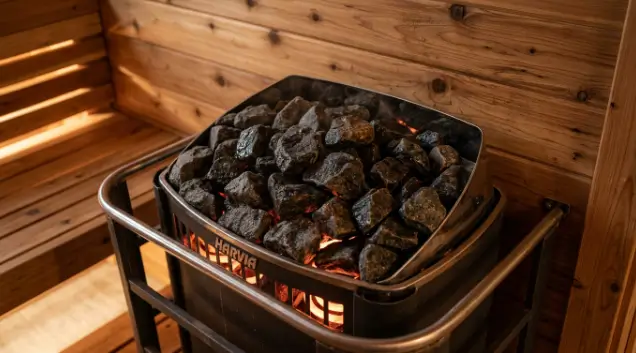
Placement inside a small cabin matters more than placement in the yard. The heater typically goes on the wall opposite the door or in a corner away from the bench line, both to keep the guard rail clear of foot traffic and to spread heat evenly across a short room. In a 4-foot by 4-foot cabin there usually isn’t a second option, so the door location effectively decides where the heater and lower bench end up. Outside, a spot with a few feet of clearance on the service side of the cabin makes future stone replacement and panel access realistic instead of a chore that requires partly disassembling the yard around it.
What Clearances and Guard Rules Apply?
Every heater ships with a printed clearance diagram showing the minimum distance from combustible material on each side, and that number changes depending on whether a guard rail or heat shield is installed. A typical unguarded 6kW heater needs several inches of air gap from the nearest wooden bench or wall stud; an approved guard rail tightens that distance and also keeps limbs and towels away from the stones and heating elements. In a small cabin these numbers aren’t a formality, they often determine whether the heater fits in the corner at all, so checking the clearance chart before ordering saves a return shipment later.
What Electrical Work Does a Small Install Need?
A 6kW heater almost always needs a dedicated 240-volt circuit sized to the manufacturer’s stated amperage, not a shared household outlet. For a backyard build this usually means running new wire from the panel to the cabin, either buried in conduit or run overhead depending on local code, plus a disconnect switch within sight of the heater in many jurisdictions. Homes with an older panel or one that’s already near capacity may need a service upgrade before the new circuit is even possible, which is worth confirming with an electrician before a heater is purchased rather than after it arrives and sits in a box.
What Does the Research Say About Regular Sauna Use?
Sauna marketing often points to health research, and some of the underlying data is solid, though narrower than most listings imply. A widely cited Finnish cohort study found that men who used a sauna four to seven times a week had lower rates of fatal cardiovascular events compared with men who used one once a week, an association that held after adjusting for other risk factors. A 2018 review in Mayo Clinic Proceedings summarized comparable cardiovascular associations, and a separate 2023 Mayo Clinic Proceedings review looked at sauna bathing alongside other lifestyle factors. These are population-level associations from mostly Finnish cohorts, not a guarantee for any individual, so shoppers with a heart condition should treat the research as a reason to ask a doctor specific questions rather than a green light on its own.
Once the cubic footage and electrical plan are settled, comparing actual heater packages side by side is worth the extra half hour. Retailers publish clearance diagrams and amperage specs by model, and buyers narrowing down a compact 6kW package can browse SweatDecks the HUUM Drop page for the exact numbers before finalizing a corner placement in a small yard.
Frequently Asked Questions
How small can a backyard sauna corner realistically be? A single-person cabin can fit in roughly a 4-foot by 4-foot footprint, and a two-person unit generally needs about 4.5 by 6 feet once you add the guard clearance around the heater. Add another foot or two on the door side for the swing radius.
Does a 6kW heater work in a small backyard cabin? Yes, for most single and two-person cabins under roughly 300 to 350 cubic feet, a 6kW electric heater is enough to reach and hold operating temperature. Larger glass area or a taller ceiling can push a borderline space past what 6kW can comfortably maintain.
Can a backyard sauna heater run on a standard household outlet? Most heaters above roughly 4.5kW need a dedicated 240-volt circuit, not a standard 120-volt outlet. A 6kW unit almost always requires a dedicated circuit sized to the manufacturer’s amperage spec, run by a licensed electrician.
How close can a heater sit to a wooden wall? Manufacturer clearance charts typically call for several inches between an unguarded heater and any combustible wall, with distances tightening when a heat shield or approved guard rail is installed. Always follow the specific clearance diagram published for the exact model.
References
- Cardiovascular and Other Health Benefits of Sauna Bathing: A Review of the Evidence, Mayo Clinic Proceedings, 2018
- Clinical Effects of Regular Dry Sauna Bathing: A Systematic Review, Evidence-Based Complementary and Alternative Medicine, 2018
- Benefits and risks of sauna bathing, The American Journal of Medicine, 2001
By Melissa Contreras